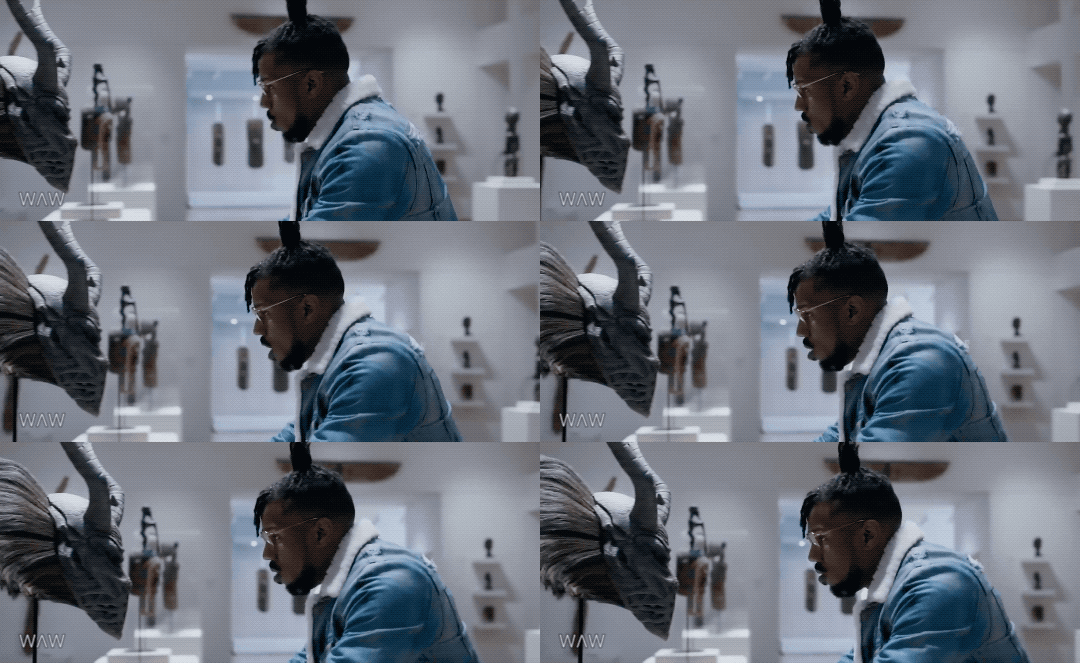
Killmonger: How do you think your ancestors got these? You think they paid a full price for it? Or did they take them like they took everything else?
I work in a museum- an old one- and during this scene I was nudging my brother the whole time. I clapped a little at that line. Museums need to rethink the way we curate things. If we aren’t elevating the heritage of those objects’ creators, if we aren’t telling their story, if we aren’t making those narratives accessible to the descendants and letting them lead, then what is even the point? Decolonize collections. Practice co-curation. Hire scholars of color, and make the collections accessible to visiting scholars. Involve the descendant community and elevate their voices, not the white colonial narrative.
And for goodness’ sakes, don’t run your museum like a jewellery shop. Have context. Honor the objects for their beauty, but remember that no object is as important as the people who created it.
Ummmm,, and like straight up, give things back? Indigenous communities in North America have campaigned for decades to have body parts, ceremonial items and sacred parts of our history returned to their communities.
Ofcourse, Hurd scholars of colour and think critically about your role. But like sometimes, you just have to give things back.
That’s repatriation (what I meant by “decolonize collections”) and it’s actually been federal law in America for almost thirty years. It’s been happening and will continue to happen, but it’s a LOT more complicated than just “give the stuff back.” Obviously you’re totally right- giving the stuff back is absolutely necessary.
But at the same time, giving ALL the old stuff back to Native groups doesn’t really work, either- for us OR for them. What happens to the stuff when it goes back? Do the modern Alaskan Athabascans really want the 1000+ baskets the museum I work at holds? (No, they don’t. We asked them. They definitely do not want those baskets back.) What about Native groups who don’t want remains back- the Navajo, for instance, believe that the remains of the dead are taboo objects, unclean and best left buried. And there are some Native groups who actually WANT their objects in museums. Not every object has a ritual context- sometimes a pot is just a pot. Even some ritual objects aren’t as spiritually important, and we’ve actually had people from different tribes come in and help rewrite language surrounding an object, or give instructions as to how it should be stored. Some groups really want us to display their cultural artifacts, because it reminds people that Native American cultures are alive and real.
One thing that works really well in a lot of cases is co-curation, which is when we commission and work with Native artists, leaders, and scholars to reframe the way we display objects. Like, recently, we asked Chris Pappan, who’s a Kanza artist, to come in and draw on the displays from the ‘30s. The juxtaposition of his art with the colonialist view of Native Americans has had a huge impact in visitor impressions- people go to that gallery now to learn and see what’s ACTUALLY happening today with Native Americans. This I think is how these institutions can use their power for good- elevating creator voices and letting them present their own past and own history. The Field does that a lot- we’ve had exhibitions from Rhonda Holy Bear, Bunky Echo-Hawk, and are continuing to work with Native Americans from many tribes to redesign and reframe the objects on display. We’re not doing this for social justice points- we’re doing this because the Field Museum gets something like 1.5+million visitors a year, and we owe it to the Native tribes we stole from to a.) tell their story b.) how they want it.
If you take all evidence of Native Americans out of the big natural history museums, you’re taking away representation- and education- and a lot of tribes actually don’t want that. What many groups want is the old colonial narratives to go away and be replaced with their own messaging and history. Native Americans are mythologized and what we did to them is sanitized in the US education system. I know that the person who responded is in Canada- and from what I hear, they’re even worse about destroying Native history and sanitizing what the colonists did (and continue to do) to them and their cultures. And this is where I think museums can actually HELP. People only care about things they’re familiar with. If the only image you have of a Native American is a racist football mascot, you’re not going to care about them as a culture- you’re not even going to see them as people. There’s a lot of white people who don’t believe in Native Americans. Like, they legit don’t think that there’s ANY Native groups left, and I know this because I’ve talked to these people at work. It’s baffling, how little Americans know about their own country’s behavior. And it’s totally a global problem- I could go on for days about what the British Museum Needs To Do With Those Fucking Marbles, Give Them Back You Cowards, You Have Enough Money To Ensure Their Care In Greece You’re Just Being Assholes- but I wanted to respond with a Native American context because of the person I’m replying to AND because… well, most Americans don’t know this, and they need to, because knowing about repatriation and why we do it is important.
Repatriation is so very vital, but it’s even more vital to listen to the Native American groups and ask them what they want to happen- as well as treat each tribe individually. We don’t hold onto Tlingit remains because the Navajo don’t want their remains back. Treating all tribes as identical is wrong- not as wrong as withholding their precious cultural traditions, relics, and remains- but if we’re even going to (as a museum industry) attempt to apologize for the atrocities we’ve sanctioned, the first thing we gotta do is ask people what they want.
And the next thing we gotta do is listen.
Skeptical. Very much so.
Skeptical? What’s skeptical? I am confused
About repatriation until the countries can show they can take care of the objects. I don’t like retroactively looting museums for the sake of correctness. Something doesn’t sit right with me.
Further, Palmyra and the Iraqi national museum comes to mind.
I don’t know. My opinions are developing on the issue.
Ahh, gotcha. Yeah, that’s certainly another issue! With Native American repatriation, the objects and remains repatriated often aren’t conserved at all- they go back into use, or in the case of remains, they’re given a burial.
But sometimes it isn’t safe! Sometimes it’s dangerous for artifacts to go back- they might get damaged (see: Iraq) or they’re so fragile that they can’t travel, or the home country can’t support them. In these cases, you can still make these objects available to the descendants- through outreach, digital resources, reproductions, and on-site work. This is super important for African art in particular- in a lot of cases, sending it back isn’t helpful, because of the way Africa got split up- if an artifact is from a group that straddles a country line, who gets it? And what if sending it back means that now diasporic descendants (who never got the chance to know exactly from who they came from) don’t get to access it? Africa is so salient for this because of the slave trade- for a lot of people of African descent, western museums are the main way they get to see the actual things their ancestors made. They live in these countries, like the US, where their history and contributions are so frequently ignored, and don’t they have the right to connect to their heritage through artifacts, too? Giving everything back would be hugely detrimental- and again, people only care about what they see.
Which is where consulting these communities comes into play. In black panther, the artifacts have no context. They say nothing about African life! They say nothing about what it means to be African, or from a specific African nation/tribe! They’re treated like trophies, and that’s bad display. I think that one of the most important goals of modern museums is education- what can these objects tell us the public, along with the cultural descendants of the creators? In many cases, repatriation isn’t the right answer- but that can’t be decided without a conversation between museums and descent groups. A good-faith convo, not one where the museum flexes its financial/cultural power, but a conversation where the desires of the people and the reality of conservation are both discussed.
And even in cases where repatriation isn’t a feasible option, co curation is almost always a possibility. You’d be surprised how many groups will happily enter into dialogue with museums who hold their cultural heritage, so long as there’s a real effort to include their voices and opinions.
It’s not a question with a simple answer. Museums have to live with the legacy of their creation as a product of colonialism, and they have to use that responsibility in a way that provides actual benefits to the people affected.

 Nava
Nava 